Arles: separate Roman from Romanesque before building a timeline
Two similar-looking words can create a surprisingly large misunderstanding in a historic city. In Arles, give Roman and Romanesque separate entries before comparing monuments. The exercise is partly about chronology and partly about language: the name of a later architectural tradition should not quietly become a claim that a building belongs to ancient Rome.
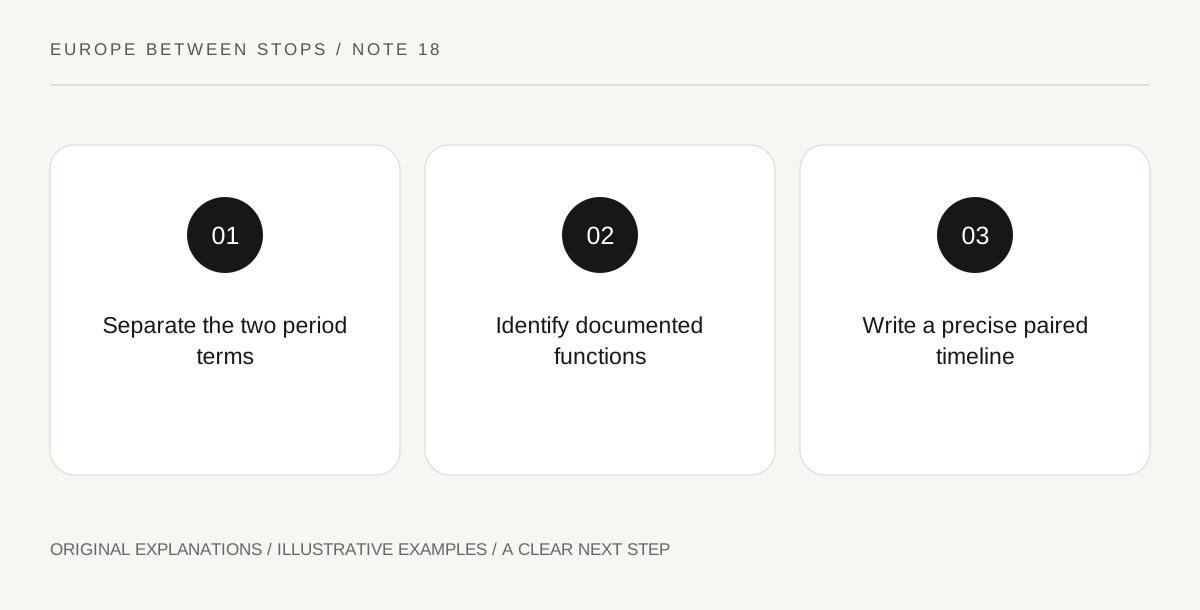
Original explanatory diagram. Read the full method and limitations below.
Read the property title as a clue
UNESCO names the property Arles, Roman and Romanesque Monuments. Its account discusses ancient Roman structures and later medieval monuments, including Saint-Trophime. The distinction is therefore built into the subject itself. Choose one officially identified example from each category using appropriate interpretation. Write the exact identification first, then explain the two words in the context supplied by the source. You do not need a universal history of architecture to avoid treating them as interchangeable labels during this visit.
Give each example a documented function
Record what the selected monument was used for according to its interpretation. Function provides a firmer comparison than simply asking which building looks older. An entertainment structure, a religious building and an underground space do not tell the same story merely because stone survives in each. Keep later uses separate when the source identifies them. Do not invent an unchanged function across centuries or assume that a monument’s present visitor experience reproduces its original arrangement.
Compare one visible relationship
At the places you are authorized to observe, select a relationship that can be described clearly: opening to wall, enclosed space to entrance, or decorative surface to larger form. Explain what is visible before attaching a technical term. Differences can help you formulate a question about use or period, but they do not independently date every component. Where entry is unavailable, an official plan or interpretation may provide a better comparison than an exterior guess. Clearly label the evidence so a later reader can distinguish observation from reference material.
Write the timeline in words as well as dates
Create two short entries using both the relevant period term and the monument’s documented role. Add any later transformation only if supported. Then reread the caption for accidental shortcuts, especially phrases that make Romanesque sound like another word for Roman. A useful outcome is a small, accurate vocabulary tied to particular places. That vocabulary will make later visits clearer without pretending that similar stonework proves the same age, purpose or cultural setting everywhere you encounter it.
Illustrative field notebook
Illustrative notebook: a visitor chooses one identified ancient monument and Saint-Trophime as separate subjects. The first draft uses Roman for both. After reading the official interpretation, the traveler revises the entries to distinguish ancient and medieval contexts and records a documented function for each. A visual comparison remains descriptive; it does not become an unsupported dating method for every unlabelled wall nearby.
Questions that come up
Does Romanesque simply mean a surviving Roman building?
No. In this property title it distinguishes a later architectural context from the ancient Roman monuments. Read the specific interpretation for each example.
Should I compare only buildings with the same function?
That can help, but unlike functions can also be informative when clearly identified. Avoid making a visual resemblance stand in for a shared use or date.
References and scope
These sources support the factual background. Examples and exercises are original illustrative teaching material. References do not imply endorsement.
- UNESCO: Arles, Roman and Romanesque Monuments — The property’s explicit ancient Roman/medieval Romanesque distinction and Saint-Trophime identification; no operational venue or access claims.