Quedlinburg: describe timber framing before guessing its age
Timber framing offers a memorable visual pattern, but a pattern is not a construction date. In Quedlinburg, separate a careful description of a house front from the historical claims attached to it. A short two-building comparison can reveal how easily the phrase medieval town becomes an unsupported date for every building in a photograph.
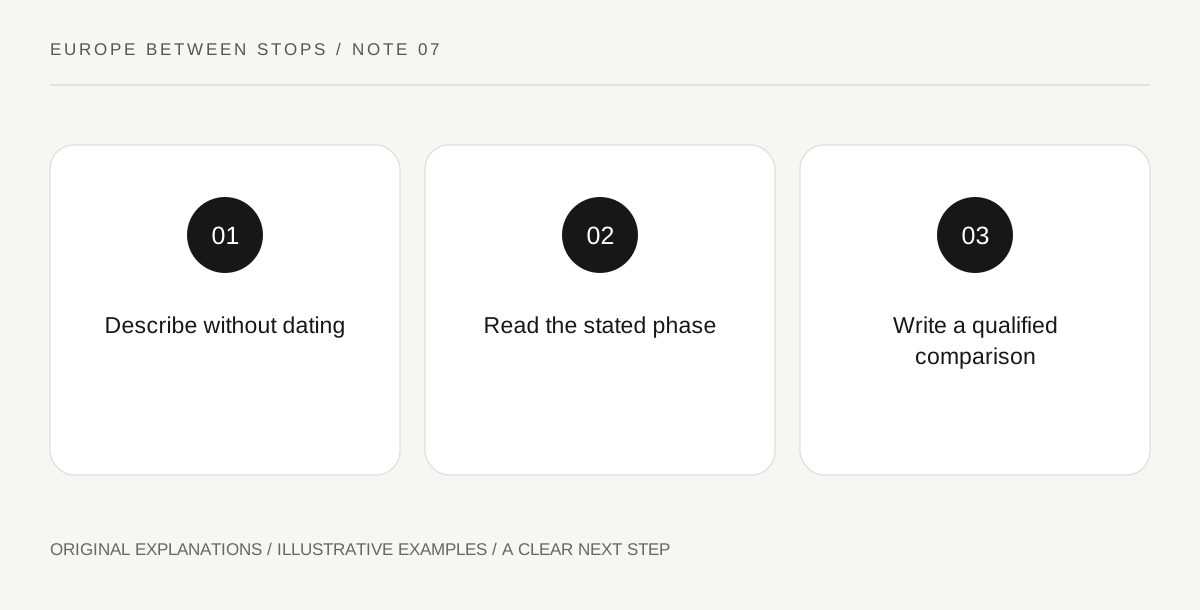
Original explanatory diagram. Read the full method and limitations below.
Use the ensemble without flattening its chronology
UNESCO identifies Quedlinburg’s collegiate church, castle and old town, emphasizing both its trading history and its timber-framed buildings. The fuller account explicitly includes medieval and post-medieval houses. That distinction gives the visit its central question: which features are visible, and which ages are actually documented? Choose two buildings with accessible public interpretation if possible. Their dates need not match, and neither has to be the most ornate house on the street for the comparison to be useful.
Write a description that needs no date
From a public position, note the arrangement of visible timber and infill, changes between storeys and the relationship of the entrance to the street. Use plain descriptions before specialist names. A diagonal member can be recorded as diagonal without claiming a structural tradition that you have not established. Keep the first note free of age words. This prevents an attractive visual impression from controlling the conclusion before you read the information that could support or challenge it.
Add the date with its proper subject
Read the official or on-site interpretation carefully. Does it date the house, a surviving part, a rebuilding or a later restoration? Put that wording beside the relevant observation. If there is no adequate information, leave the age field unresolved. Similar framing patterns do not establish that two buildings were built together. Nor does a freshly finished surface prove recent construction. The comparison becomes richer when appearance and documentation do not line up neatly, because it shows why building history requires more than a quick stylistic guess.
Keep the wider town in the final note
After the two-building study, return to the ensemble scale. Ask how the variety of houses relates to your initial expectation of one uniform medieval scene. You do not need to solve every alteration to recognize continuity through change. End with a caption that pairs a visible feature with a properly qualified historical statement. If a photograph is permitted, the caption should help a later reader see the distinction rather than merely naming an old-looking street. That habit travels well to other historic towns without turning them into interchangeable scenery.
Illustrative field notebook
Illustrative comparison: two visitors choose a pair of labeled timber-framed houses. Their first notes describe diagonal members and upper-storey divisions without dates. One interpretation identifies a later phase that their initial impressions had missed. The final caption records that documented phase and keeps the other building’s unresolved details open. The exercise changes the explanation without requiring either house to be dismissed as less interesting.
Questions that come up
Can timber framing alone prove a medieval date?
No. The property includes houses from different periods. A specific date needs evidence about the specific building or component.
Does restoration make observation pointless?
No. It makes the distinction between appearance and documented history more useful. Observe what is present while using interpretation to understand its phases.
References and scope
These sources support the factual background. Examples and exercises are original illustrative teaching material. References do not imply endorsement.
- UNESCO: Collegiate Church, Castle and Old Town of Quedlinburg — The ensemble and the presence of medieval and post-medieval timber-framed houses; the descriptive exercise supplies no inferred building dates.