Trier: give each monument its own time card
A city associated with Roman history can tempt visitors to place every important building on one mental timeline. In Trier, use separate time cards for a small selection of identified monuments. The aim is to distinguish what survives, which historical phase a label describes and how a building’s later life complicates the first impression.
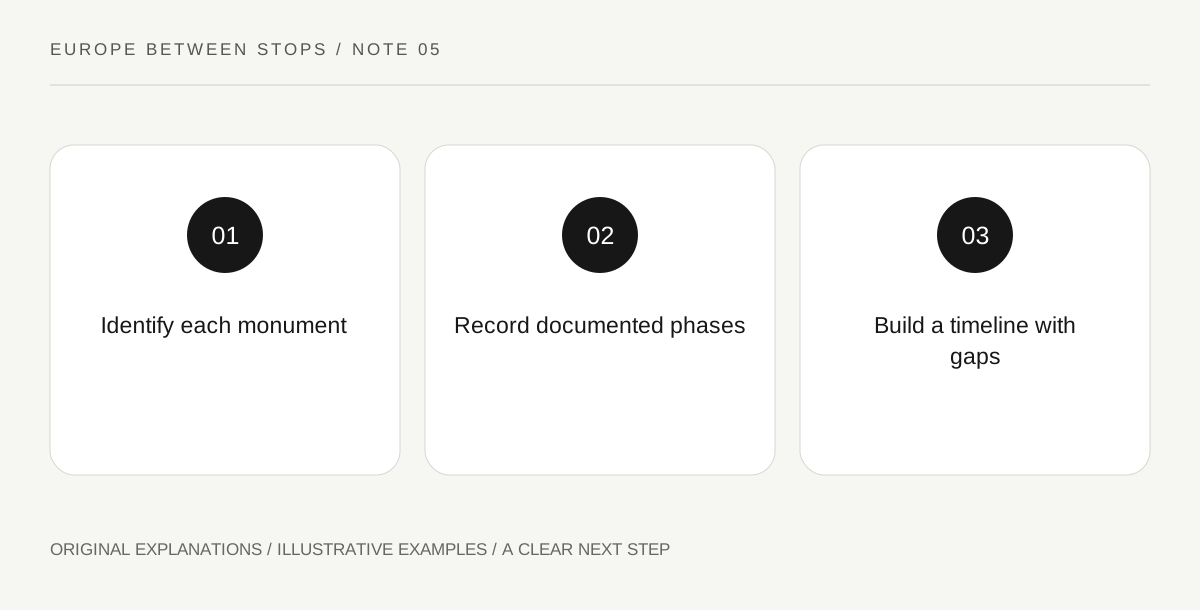
Original explanatory diagram. Read the full method and limitations below.
Keep the ensemble title in view
The UNESCO property is explicitly named for Roman monuments, the Cathedral of St Peter and the Church of Our Lady. Its account explains Trier’s importance as a Roman city and the quality of surviving monuments. The title itself encourages attention to more than one kind of building. Choose two or three identified elements from official property information. Give each its own card rather than putting everything under a single Roman heading that may conceal a very different history.
Separate object, phase and statement
On each card, create three short fields: what is being identified, which phase the source discusses and what the source actually says. A monument may contain evidence from more than one period, so a date attached to one phase is not automatically the date of every visible surface. Copy only a brief identifying term and explain the distinction in your own words. If a label leaves the relationship unclear, put a question mark beside that field instead of smoothing the uncertainty into a confident chronological story.
Compare unlike buildings carefully
Look for a visible feature that can be described without pretending the buildings had identical functions. The scale of an entrance, the arrangement of an exterior or a change in material may provide a useful question. Avoid rating one monument as more authentic merely because it appears older or less altered. Your comparison should ask what evidence is available and what kind of history it can support. Religious buildings also have present uses; let posted conditions and ongoing activities determine whether an interior observation is appropriate.
Build a timeline with gaps allowed
Lay the cards in the order established by the documented phases. Leave space between them and write later changes beneath the relevant card when known. The spaces are part of the method: a short visit does not provide continuous evidence for every century. Finish with one sentence about a transition you can actually explain. This gives the day a historical shape without converting a handful of monuments into an invented complete history of Trier. The most valuable result may be realizing that one familiar label has been doing too much work.
Illustrative field notebook
Illustrative cards: a traveler selects a documented Roman monument and a separately identified church. They record the historical phase discussed at each site and notice that one label concerns a later transformation. Their final timeline shows two supported phases and an explicit gap. It makes no claim that an unlabelled wall belongs to the same construction campaign simply because it looks similar.
Questions that come up
Is a later alteration a reason to ignore a monument?
No. A documented alteration can be central to understanding its later life. The task is to identify the phase accurately, not seek an imagined untouched building.
How many cards make a useful visit?
Two or three well-supported cards can be enough. A comparison that you can explain is more useful than a long chronological list assembled from uncertain impressions.
References and scope
These sources support the factual background. Examples and exercises are original illustrative teaching material. References do not imply endorsement.
- UNESCO: Roman Monuments, Cathedral of St Peter and Church of Our Lady in Trier — The ensemble identity and Trier’s Roman importance; no unsupported date is assigned to individual visible fabric.