Toruń: read Old Town and New Town as historical names
The word new can quietly distort a visitor’s expectations when it appears on a historic-town map. In Toruń, treat Old Town and New Town as names that need historical context, not as an automatic contrast between medieval and modern scenery. Compare the identified areas through evidence of their roles and surviving buildings rather than trusting the labels alone.
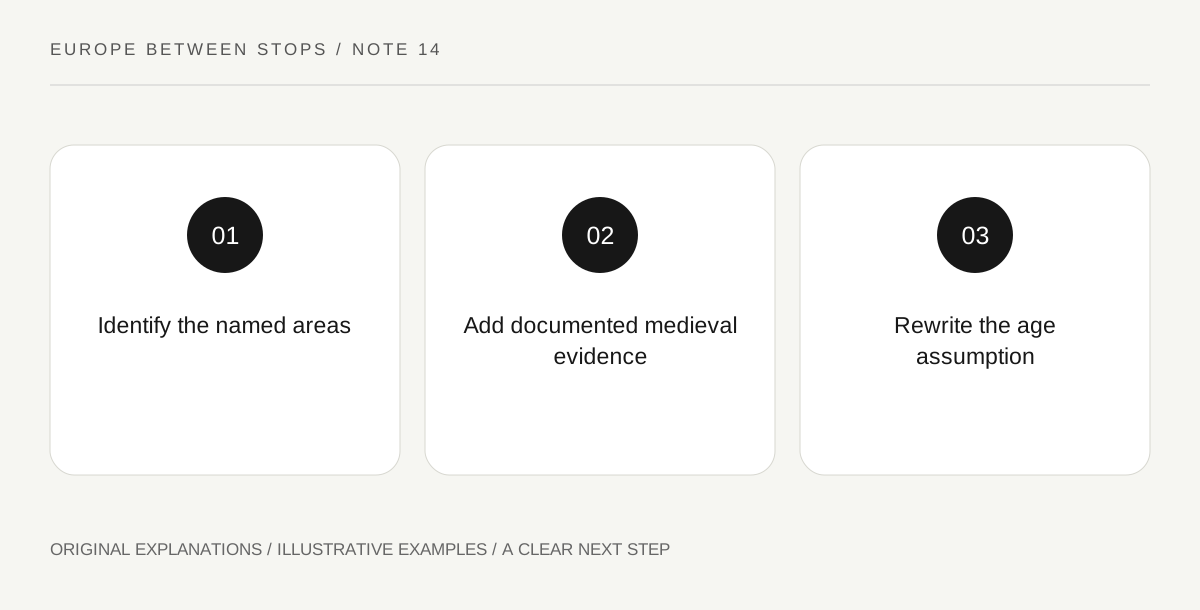
Original explanatory diagram. Read the full method and limitations below.
Let the source challenge the everyday meaning
UNESCO’s account describes medieval public and private buildings in both Toruń’s Old and New Town, within a history involving the Teutonic Order and Hanseatic commerce. That is enough to show why new is a relative historical label here. Identify the named areas through official property information before setting expectations. Do not assume that a name supplies a construction date for each building inside it. Likewise, the castle’s historical role should be established through interpretation rather than borrowed from the appearance of nearby streets.
Make a three-part identity card
Give each area a card with its proper name, documented historical context and one clearly identified feature to investigate. Keep a separate card for the castle if it is part of your inquiry. The cards are not a demand to visit everything in one session. They prevent the places from collapsing into a single vague medieval centre. Where the source provides no direct comparison, write a question such as which institutions organized this area, rather than filling the card with an assumed difference in age or wealth.
Compare public and private evidence
Choose a labeled public building or interpretation and, where appropriate, a documented private-building example. Ask what each can reveal about the town’s organization. A large exterior may suggest a question about status, but its size does not establish an owner’s precise income or occupation. Use actual interpretation for those claims. Notice also what is unavailable: a street-facing house does not provide automatic evidence about its interior. The exercise becomes useful when different evidence types are allowed to answer different questions instead of being forced into one ranking.
Replace the misleading shortcut in the final caption
Write a caption for your chosen comparison without using new to mean recent. Include the proper area names and a supported historical distinction, or state that the available evidence does not yet establish one. This small wording change can correct the mental map you carried into the visit. You can still enjoy architectural details while leaving some chronology unresolved. The final result is a more accurate understanding of named urban areas, which is useful in many European towns where relative names have outlived the circumstances that created them.
Illustrative field notebook
Illustrative cards: a traveler initially expects Toruń’s New Town to provide a modern contrast. Official interpretation identifies medieval buildings there as well as in the Old Town. The revised notebook keeps the proper names, adds one documented feature to each card and leaves questions about their differing institutions open. The caption describes the evidence rather than repeating the original mistaken age contrast.
Questions that come up
Does new always mean the same thing in European town names?
No. Its meaning depends on local history. Establish the particular context rather than importing an assumption from another city.
Must I compare every building in both areas?
No. One or two well-identified examples can correct a misleading expectation. Keep the scope of the conclusion proportional to the evidence.
References and scope
These sources support the factual background. Examples and exercises are original illustrative teaching material. References do not imply endorsement.
- UNESCO: Medieval Town of Toruń — Medieval buildings in both Old and New Town and the Teutonic/Hanseatic context; no individual ownership or comprehensive chronology is invented.