Avignon: let the surviving bridge ask a different question from the palace
A palace and a bridge can share one heritage title while asking visitors to notice very different things. In Avignon, treat the surviving bridge as evidence of a former connection and the papal complex as an institutional ensemble. A focused comparison can reveal how power, movement and the river setting belong together without turning them into one undifferentiated monument stop.
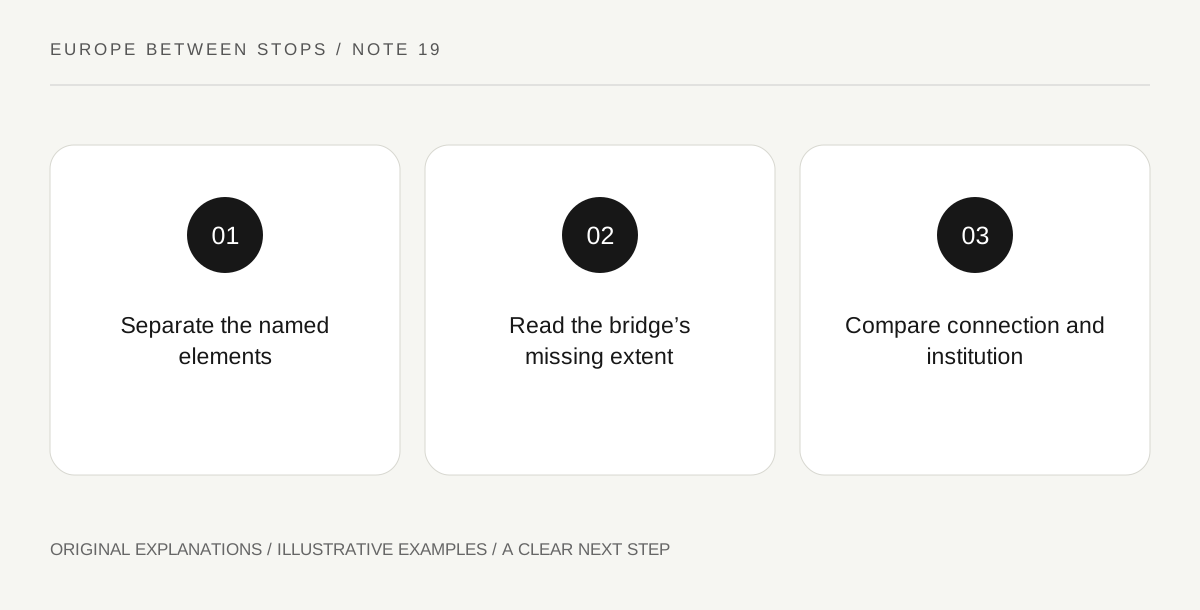
Original explanatory diagram. Read the full method and limitations below.
Identify the distinct elements in the title
UNESCO’s property includes the Papal Palace, an episcopal ensemble and Avignon Bridge. Its account connects the palace with the city’s fourteenth-century papal role and identifies the remains of an earlier bridge over the Rhône. These facts establish two different subjects for inquiry. On an official map, mark the named elements and the river. Do not assume the heritage title establishes a shared ticket, a continuous visitor route or permission to enter every space between them.
Ask what a fragment can establish
For the bridge, begin with what the surviving form and interpretation actually show. A remnant can establish that a structure once related to a wider crossing without revealing its entire former experience from one view. Look for an official reconstruction or explanation if you want to understand the missing extent. Keep surviving material, interpreted reconstruction and personal imagination in separate notebook fields. That distinction lets an incomplete monument become informative without mentally repairing it into a certainty unsupported by the evidence.
Give the institutional ensemble another question
For the palace or episcopal buildings, ask what the interpretation establishes about institutional purpose and representation. Describe a visible relationship such as scale, approach or grouping only from an authorized position. A formidable exterior may prompt a question about authority, but it does not explain every room’s use or every historical decision. The contrast with the bridge should concern different kinds of evidence: one associated with connection across water, another with institutions concentrated in the city. Let the source, rather than an atmospheric impression, supply the historical link.
Connect them without inventing a single story
End with three short statements: what survives of the connection, what the institutional interpretation explains and what relationship remains to investigate. You may be interested in how river movement supported the city, but a short visit does not automatically establish a particular person’s journey or a precise trade route. Leave those as questions. A shared setting can organize a thoughtful comparison while the monuments retain their distinct histories. That produces a stronger account than describing the bridge merely as a scenic accessory to a palace photograph.
Illustrative field notebook
Illustrative notes: a traveler studies an official bridge reconstruction beside a view of surviving material, then reads an interpretation of the papal complex. Their notebook labels reconstruction separately from observation. The final comparison names connection and institution as different subjects and asks how the river setting related to the city’s wider role. It includes no invented medieval crossing, visitor permission or common-ticket assumption.
Questions that come up
Is an incomplete bridge less useful for understanding the city?
No. Its surviving and missing parts can raise precise questions, especially when official interpretation distinguishes evidence from reconstruction.
Does the shared property title establish one visitor package?
No. Verify actual arrangements for each intended visit. A cultural relationship does not by itself supply practical booking terms.
References and scope
These sources support the factual background. Examples and exercises are original illustrative teaching material. References do not imply endorsement.
- UNESCO: Historic Centre of Avignon, Papal Palace, Episcopal Ensemble and Avignon Bridge — The named elements, fourteenth-century papal context and surviving bridge remains over the Rhône; no detailed route or admission assertion.