Brugge: connect a narrow plot to a public institution
A Brugge visit can move beyond collecting attractive street scenes by comparing two scales: the individual urban plot and the larger public institution. Choose a modest stretch of street and one identified civic or religious building. The question is how private edges and collective spaces help make the historic centre understandable as a working town.
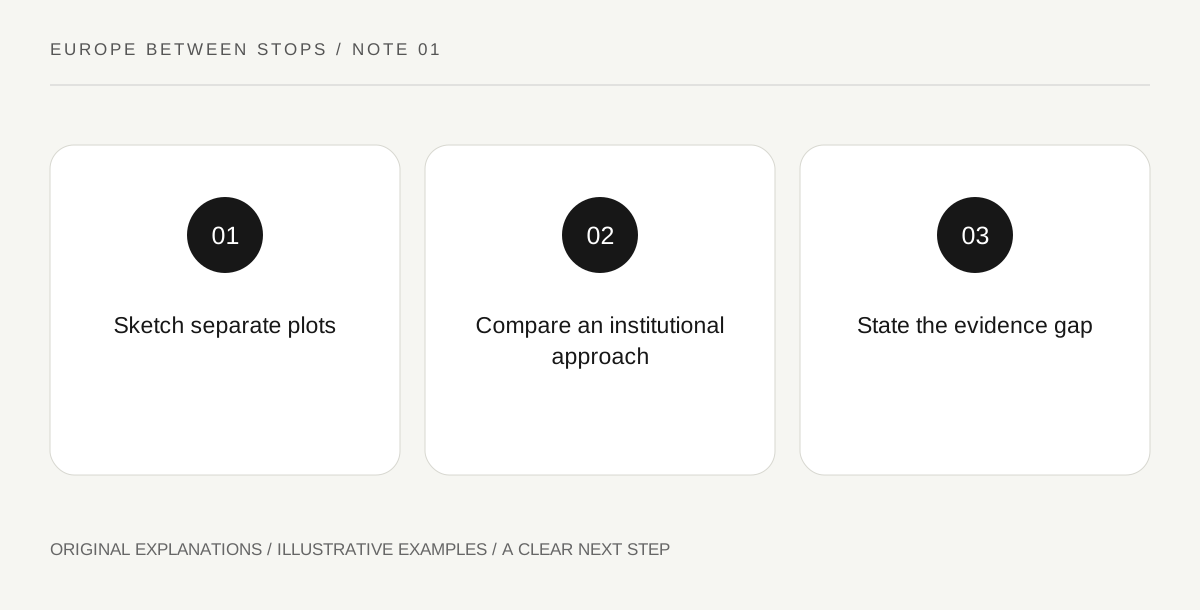
Original explanatory diagram. Read the full method and limitations below.
Start with an urban relationship
UNESCO describes Brugge as a historic settlement whose fabric evolved over centuries, with commercial and cultural institutions central to its significance. Its account also emphasizes the pattern of enclosed plots, streets and lanes. Use those points to frame a comparison, rather than assigning a medieval date to every attractive frontage. Mark a street segment and a named institution on a current map. Your task is to notice their relationship at ground level, not to reconstruct an entire trading system from a photograph.
Draw the ordinary edge first
From a permitted public position, sketch the boundary between street and buildings without decorating the drawing. Mark separate entrances, changes in frontage width and any passage whose public status is clear. The exercise needs no measured survey. A rough drawing can reveal that a single picturesque scene contains multiple addresses and different levels of access. Leave an uncertain doorway unclassified. A historic-looking entrance is neither evidence of age by itself nor an invitation to investigate the space behind it.
Change the scale deliberately
Now look at the identified institution using its official interpretation or a reliable on-site label. Record what function is actually documented, then observe how its entrance or open setting differs from the street segment. Does the approach organize attention toward one large threshold, several smaller ones or a wider gathering space? These are questions to test, not assumed properties of every institution. Keep the observed arrangement distinct from the historical explanation. The contrast becomes useful because each side has a specific location and a stated basis.
Write a relationship rather than a verdict
End with two sentences. The first describes a visible difference in plot, frontage or approach. The second explains what additional evidence would connect that difference to the town’s history. Avoid conclusions such as every narrow house belonged to a merchant unless a source establishes that particular history. You can understand more about an urban pattern while knowing less about individual owners. That restraint leaves a sharper memory than calling the whole centre unchanged, which erases the successive adaptations that make a historic city a city.
Illustrative field notebook
Illustrative note: a visitor sketches several separate entrances along one street and compares them with the approach to a documented civic building. The notebook records repeated individual thresholds beside a collective entrance. It does not assign trades to the houses. A question about how the institution related to nearby commercial activity becomes a useful subject for a later museum label or guide conversation.
Questions that come up
Must I recognize every architectural style?
No. Entrances, frontage divisions and the relationship to the street offer a concrete starting point. Add style terms only when you can explain what feature supports them.
Does the heritage designation mean everything is medieval?
No. The source describes a historic fabric that evolved over centuries. Investigate individual dates and changes instead of assigning the ensemble one universal construction period.
References and scope
These sources support the factual background. Examples and exercises are original illustrative teaching material. References do not imply endorsement.
- UNESCO: Historic Centre of Brugge — Historic urban continuity, commercial and cultural institutions, and the retained pattern of plots, streets and lanes; no individual building dates or access claims.