Telč: compare the continuous arcade with the individual house
Telč’s market square offers a useful visual puzzle: a continuous frontage can also contain strongly individual houses. Study those two scales separately before calling the square uniform. A simple rhythm drawing and one close description help explain how an ensemble can feel coherent without requiring every facade, opening or decorative choice to be the same.
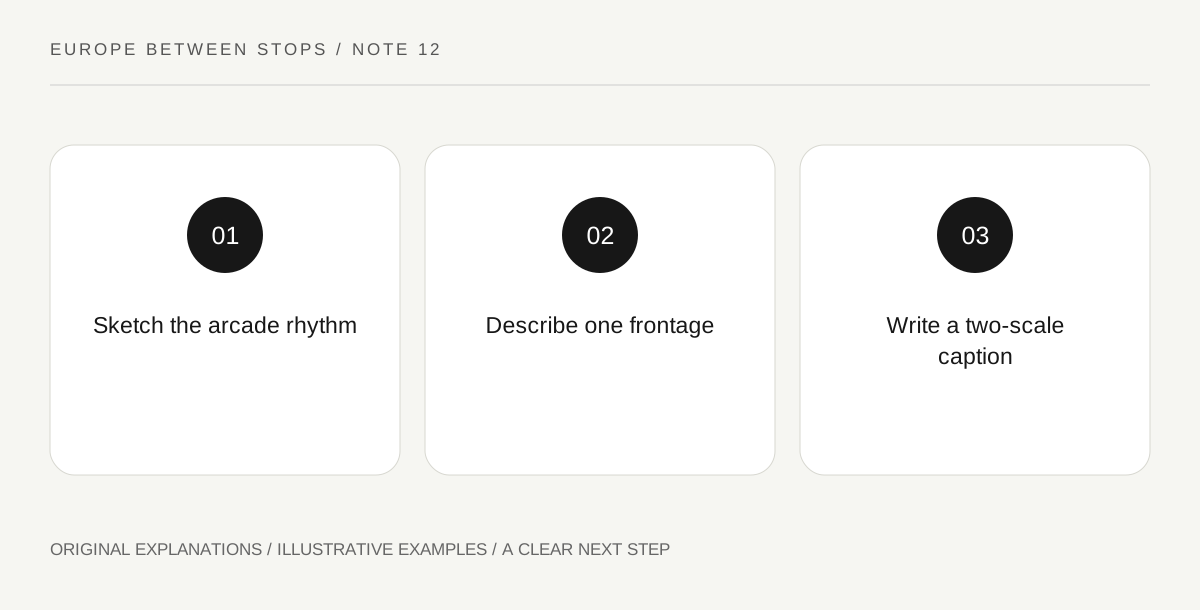
Original explanatory diagram. Read the full method and limitations below.
Name the shared element first
UNESCO describes Telč’s triangular market square as lined by houses linked through a continuous arcade, with varied facade decoration and origins extending across periods. That account supplies the comparison: connection at one level, difference at another. Use an official plan to identify the square, then choose a permitted public position where a short section is visible. The exercise concerns the relationship among houses, not a claim that all arcade sections have identical dimensions or that every building is open to visitors.
Draw a rhythm without ornaments
Sketch a short run of openings using simple marks. Note repetition, breaks and the relationship to entrances, while leaving decorative details aside. The drawing can be approximate; it is an observation aid rather than a measured architectural survey. Ask what makes the sequence read as continuous from where you stand. Keep a clear path for other users and do not stand in a doorway for a perfect view. An ensemble is also a present urban place, so the task should fit ordinary public use.
Give one house a separate description
Now select an identified house within the same visible section and describe its upper frontage in plain terms. Compare its outline, window arrangement or decoration with the neighboring house without assigning a date from color or ornament alone. Notice whether the arcade’s shared rhythm and the individual facade emphasize the same divisions. Where they do not seem to align, write a question rather than inventing a building history. Official interpretation can explain a particular alteration; a first glance cannot reliably supply its cause.
Combine the two scales in one caption
Write a sentence about what connects the frontage and another about what distinguishes the selected house. Read them together and ask whether either overstates uniformity. The point is not to prove a grand theory of Renaissance design from a short visit. It is to identify a visible relationship that a single postcard adjective might conceal. Keep the sketch and the house note side by side. Later, they will show why this square was memorable as both a collective space and a sequence of particular buildings.
Illustrative field notebook
Illustrative drawing: a traveler records a short series of arcade openings as repeated marks, then describes the outline of one house above them. The first sketch emphasizes continuity; the second preserves difference. A question about an apparent change in alignment remains open until supported by interpretation. The final caption avoids calling the square either completely uniform or merely a collection of unrelated colorful houses.
Questions that come up
Do I need exact measurements to compare the two scales?
No. An approximate sketch can record repetition and difference. Do not present it as measured evidence for architectural proportions.
Are all visible houses from the same period?
The source describes a layered ensemble. Investigate individual histories separately instead of extending one stylistic impression to the whole square.
References and scope
These sources support the factual background. Examples and exercises are original illustrative teaching material. References do not imply endorsement.
- UNESCO: Historic Centre of Telč — The triangular square, continuous arcade, varied facades and layered house origins; no exact dimensions or individual-house dates.