Graz and Eggenberg: turn one heritage title into two different studies
A shared heritage designation can make a city centre and a palace seem like one continuous attraction. For Graz and Schloss Eggenberg, choose two distinct observation tasks before deciding whether both belong in the trip. The useful comparison asks how urban fabric and a designed estate express related histories at different scales and under different visitor arrangements.
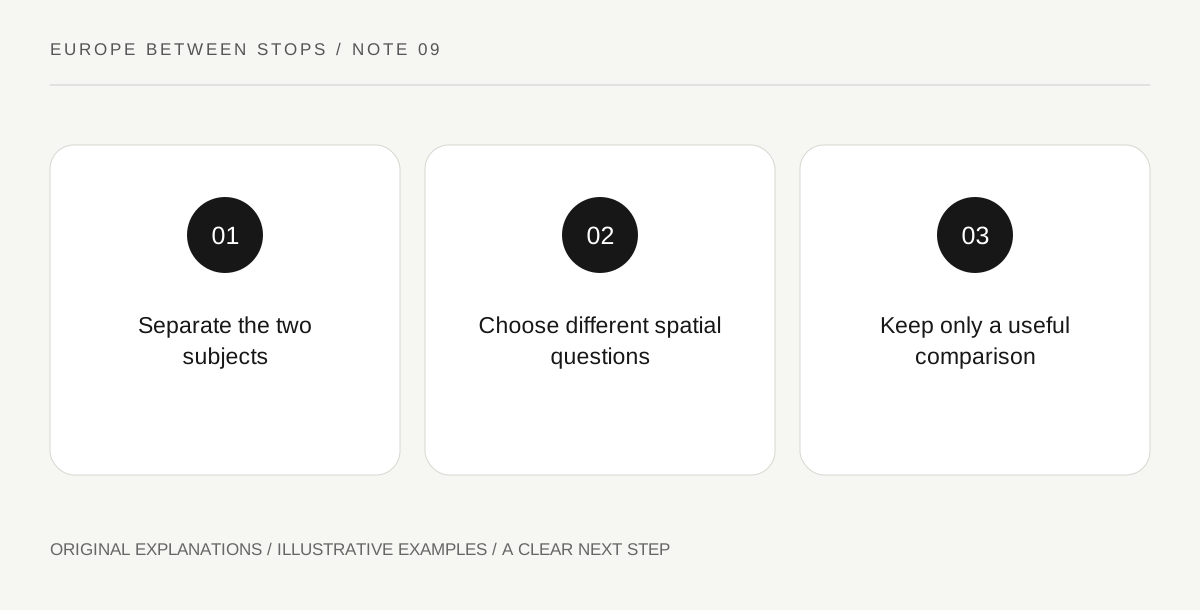
Original explanatory diagram. Read the full method and limitations below.
Name the two subjects accurately
UNESCO’s property joins Graz’s historic centre with Schloss Eggenberg and describes architectural and artistic influences from several European regions across successive periods. This gives a basis for comparison without making the two places interchangeable. Write one line for the city-centre study and another for the palace-and-setting study. Their inclusion in one property says why they matter together; it does not establish common opening times, a shared ticket or a single manageable block of sightseeing.
Use the centre to study adjacency
For the urban part, choose a small area where identified buildings or spaces can be compared from authorized public positions. Ask how different forms sit beside each other: entrance to street, taller volume to smaller frontage, or one building line to the next. Do not assign an influence merely because a detail resembles a picture from another country. Let official interpretation supply any historical connection. The original task is to notice how a city accommodates relationships between neighboring elements, rather than treating every facade as a detached masterpiece.
Use the estate to study an organized setting
If current arrangements permit a palace or grounds visit, ask a different question there: how is attention organized within a designed ensemble? Use the actual visitor plan and signs to identify the permitted area. Notice relationships among building, approach and landscape without assuming every visible path is open. The comparison works because the question has changed. You are examining an organized setting rather than simply repeating the city-centre search for adjacent facades in a larger, more decorative location.
Decide whether the second study adds enough
Before purchasing or arranging an additional visit, explain what the estate would add that the urban study cannot. Check its actual access requirements separately. If the available time or visitor format does not serve your question, keep the city study and use official interpretation to understand the wider property. A partial visit can remain intellectually complete when its limits are clear. The final notebook should contain one supported comparison, not a claim that two quick glimpses amount to understanding every artistic influence named in the designation.
Illustrative field notebook
Illustrative plan: a traveler records how two identified city-centre buildings meet the same public space. For Eggenberg they propose a separate study of approach, building and landscape, then check the operator’s actual visitor format. The second visit is retained only because it answers that different question. The shared heritage title never becomes an assumed ticket, timetable or interior-access promise.
Questions that come up
Must both parts fit into one day?
No such requirement follows from a shared designation. Let your questions, current access and practical itinerary determine whether both are appropriate.
Can I understand the comparison without entering every room?
Yes. A clearly scoped observation can be useful, provided you say what was actually accessible and avoid claims about interiors you did not examine.
References and scope
These sources support the factual background. Examples and exercises are original illustrative teaching material. References do not imply endorsement.
- UNESCO: City of Graz – Historic Centre and Schloss Eggenberg — The combined property and its architectural/cultural exchanges across periods; no common ticket, schedule or access is implied.