Salzburg: inventory what a framed old-town view leaves out
A striking Salzburg view can make the historic centre appear like a single composed scene from one period. Use that first impression as the beginning of a study rather than its conclusion. Compare the view’s framing with the evidence of different building phases, and ask which parts of an urban story disappear when one image becomes the whole city.
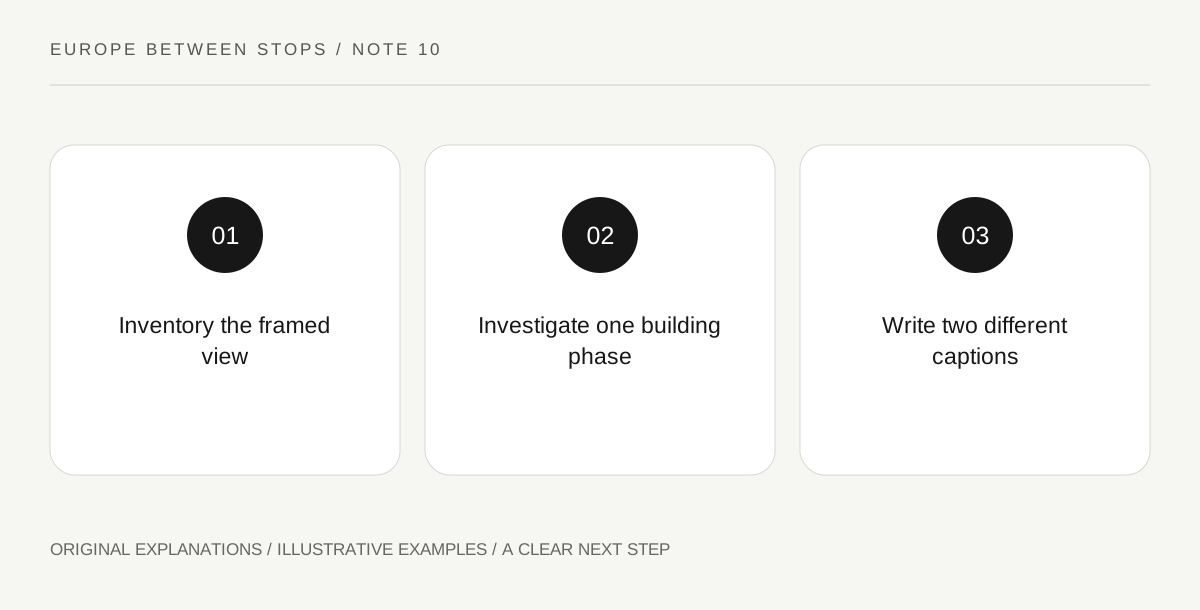
Original explanatory diagram. Read the full method and limitations below.
Give the first image a boundary
UNESCO describes Salzburg’s urban fabric as developing from the Middle Ages into the nineteenth century, with important Gothic and Baroque contributions. That range should complicate a one-period mental picture. Choose one established public view or an official image if an outdoor observation does not suit the day. Mark the image boundary and list only the clearly identifiable elements inside it. A frame is selective by definition; recognizing that selection is the point, not a criticism of enjoying an attractive scene.
Make a visible and invisible list
On one side, describe what the frame emphasizes: a large roof mass, a tower, repeated windows or the relationship between buildings and surrounding space. On the other, list what the view cannot establish, such as interior organization, earlier building phases or the lives of particular inhabitants. Avoid turning invisible into unimportant. The exercise shows why a skyline can be a useful introduction while remaining weak evidence for a detailed historical claim. It also helps identify the next question instead of merely seeking a second version of the same photograph.
Choose one documented phase to investigate
Select an identified element and read an appropriate official interpretation about its history. Record the specific phase being discussed, then ask whether that phase is actually legible in the first image. You may discover that the view reveals form while concealing a complicated sequence of changes. Do not assign every neighboring structure the same date or label. One well-supported investigation gives more depth than hurriedly applying Gothic and Baroque tags to the entire panorama based on shape alone.
Write two captions for the same scene
The first caption should describe the view as an image: what organizes attention and what falls outside the frame. The second should state one documented historical point with its limits. Compare the captions and notice how much more the second depends on interpretation. Keep both. Together they preserve the visual pleasure and the inquiry it prompted. Your resulting memory of Salzburg becomes a specific scene accompanied by a useful qualification, rather than an attractive but misleading claim that the whole historic centre belongs to one moment.
Illustrative field notebook
Illustrative exercise: a traveler begins with a public view dominated by an identified large building. Their image caption describes the grouping of visible forms. A later official interpretation explains a particular building phase that the distant view cannot establish on its own. The historical caption names that phase and its source, leaving surrounding buildings undated. Both captions remain in the notebook because they answer different questions.
Questions that come up
Does this require an elevated viewpoint?
No. Any authorized view or suitable official image can provide a frame. Do not add a climb merely to make the exercise seem more substantial.
Is a Baroque impression necessarily wrong?
It may reflect an important visible contribution. The limitation is extending that impression to every element and phase without evidence.
References and scope
These sources support the factual background. Examples and exercises are original illustrative teaching material. References do not imply endorsement.
- UNESCO: Historic Centre of the City of Salzburg — The historic fabric’s development across periods and Gothic/Baroque contributions; no specific viewpoint route or access claim.