Antwerp’s Plantin-Moretus complex: follow the evidence behind a printed page
At a printing museum, a press can dominate attention so completely that publishing disappears. Use the Plantin-Moretus complex to ask how an object, an archive and a finished page provide different kinds of evidence. A focused visit follows a question about production and business rather than trying to memorize every machine or reproduce its operation.
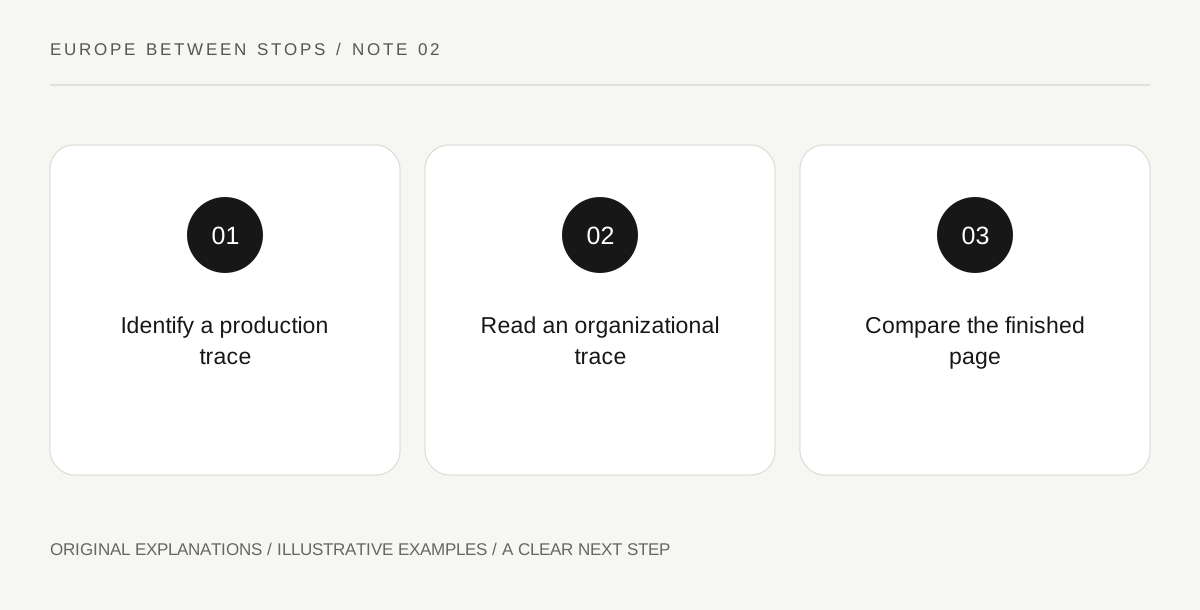
Original explanatory diagram. Read the full method and limitations below.
Give each kind of evidence a role
UNESCO identifies the Antwerp complex as a historic printing and publishing house containing equipment, a library and extensive archives. Those collections support a broader question than how a press looks. Make three notebook headings: making, organizing and circulating. They are your interpretive categories, not a claim about the museum’s room sequence. An object may reveal a production task, while a document may explain a business decision that the object cannot. Begin by seeking one clearly labeled example for each kind of evidence available during your visit.
Read a machine through its label
Choose a displayed object and record its museum identification before interpreting it. Write what job the label assigns to it and which part of a printed page that job might help explain. Do not infer an operating method from a silent mechanism or touch equipment to test a guess. A useful note can remain modest: this object relates to one stage, and another stage is still unexplained. That is a stronger starting point than treating every old press as if it performed the whole publishing process alone.
Ask what a business record adds
When an archive item or reproduction is displayed, look for the type of information it contains rather than searching only for a famous signature. Does the interpretation identify a person, an order, a financial entry or correspondence? Record only what the label establishes. Then ask which decision would remain invisible if you had seen the machine alone. A small administrative record can turn an anonymous printed object into evidence of coordination. If the item is untranslated or difficult to read, acknowledge that limit rather than improvising its contents.
Let the finished page complicate the story
Compare the visible page with your first two notes. Notice its arrangement, density or relationship between text and image, then ask what further expertise would be needed to explain those choices. The aim is not to deduce an entire production history from appearance. It is to recognize that making, publishing and reading leave different traces. End with one connection supported by the display and one open question. This approach produces a coherent visit even when only a small portion of the collection receives your attention.
Illustrative field notebook
Illustrative sequence: a visitor records a labeled production object, a displayed business document and a finished book page. The object explains a task; the document identifies a relationship; the page raises a design question. Their final note links only the stages that the interpretation actually connects. It leaves the identities of uncredited workers unresolved rather than turning a compelling narrative into invented biography.
Questions that come up
Do I need technical printing knowledge beforehand?
A question about the role of each evidence type is enough. Museum interpretation can supply terminology while you avoid guessing how equipment worked.
Can every displayed item be connected to one particular book?
Only make that connection when the display or another appropriate source establishes it. Items from the same collection do not automatically document the same production event.
References and scope
These sources support the factual background. Examples and exercises are original illustrative teaching material. References do not imply endorsement.
- UNESCO: Plantin-Moretus House-Workshops-Museum Complex — The Antwerp complex as a printing and publishing house with equipment, library and archives; the observation framework is original.