Tarragona: keep the Roman fragment separate from the proposed whole
Archaeological remains in a living city can require more imagination than an intact monument, which makes the evidence boundary especially important. In Tarragona, choose one officially interpreted fragment and study how it relates to a proposed larger structure. The aim is to understand what the fragment establishes, what interpretation adds and which parts of the ancient city remain unresolved.
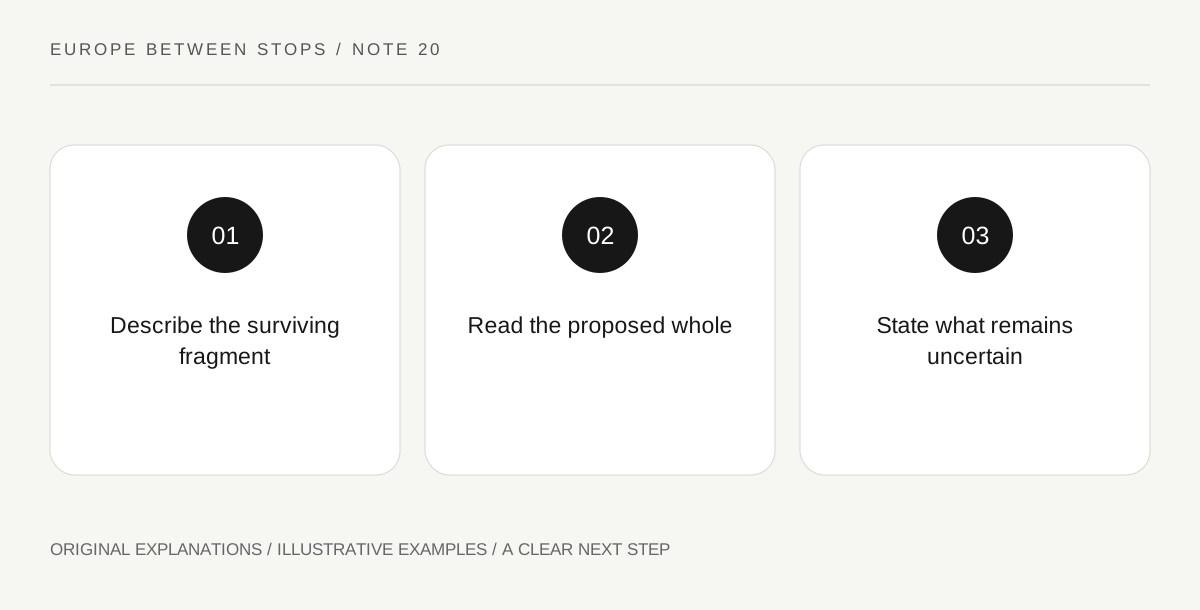
Original explanatory diagram. Read the full method and limitations below.
Expect an ensemble of surviving pieces
UNESCO’s Archaeological Ensemble of Tarraco concerns the Roman city now known as Tarragona. Its account emphasizes administrative and commercial importance, fragmentary remains and survival beneath later buildings. This is a useful reason to abandon the expectation of one complete ancient precinct. Identify the particular component you intend to study through official information. The ensemble name supplies cultural context, but each component’s location, current visitor arrangements and interpretive material still need to be established separately.
Describe the fragment before the reconstruction
At an authorized viewing position or through a suitable official image, write a plain description of the surviving evidence. It might concern a material edge, a change in level or the relationship between exposed fabric and later construction, depending on the selected component. Do not fill missing walls into the description. The point is to preserve an honest first layer of evidence. A small fragment can be significant without looking impressive or resembling the complete building that a reconstruction later proposes.
Read the interpretation as an argument
Now examine the official diagram, model or text explaining the larger structure. Record which part corresponds directly to the observed fragment and which part represents a broader interpretation. Look for indications of uncertainty rather than assuming that every drawn line has the same evidential status. A reconstruction is a tool for understanding, not a second surviving monument. If the explanation does not reveal how a particular conclusion was reached, note the question. You can appreciate the proposed whole while keeping its supporting evidence visible.
Notice the city around the evidence
Finally, record how the archaeological subject relates to the later city in the permitted view. Avoid treating modern life as an obstruction that ought to be mentally erased. The survival of remains beneath or among later buildings is part of the ensemble’s character. Write a final paragraph with three clear verbs: survives, is interpreted and remains uncertain. This structure can explain a modest piece of evidence more accurately than a dramatic imagined panorama. It also gives the living city a place in the account instead of pretending the visit took place outside time.
Illustrative field notebook
Illustrative record: a traveler selects one officially identified component and first describes only visible surviving fabric. An interpretation then proposes the wider structure, which is drawn in a different notebook line style. The last note records its relationship with later buildings. The caption distinguishes observed material, official reconstruction and an unanswered question, without claiming that every part of the proposed ancient complex is exposed or accessible.
Questions that come up
Does a detailed reconstruction mean all of it survives?
No. A reconstruction may bring together different evidence and interpretation. Read how it relates to the actual remains rather than assuming every drawn feature is visible.
Should later buildings be excluded from the notebook?
No. Their relationship to surviving remains can be part of the question. Describe it appropriately without assuming that the ancient city can be understood by mentally deleting everything later.
References and scope
These sources support the factual background. Examples and exercises are original illustrative teaching material. References do not imply endorsement.
- UNESCO: Archaeological Ensemble of Tarraco — Roman administrative/mercantile context, fragmentary remains and preservation beneath later buildings; no component opening or reconstructed detail is invented.