Urbino: change scale between a cultural monument and the hill town
A major cultural building can occupy so much attention that the town around it becomes only an approach. In Urbino, reserve part of the visit for a change of scale. Compare one documented monument-related question with a public-space observation about the hill town, so that the setting becomes part of the inquiry rather than background between ticketed rooms.
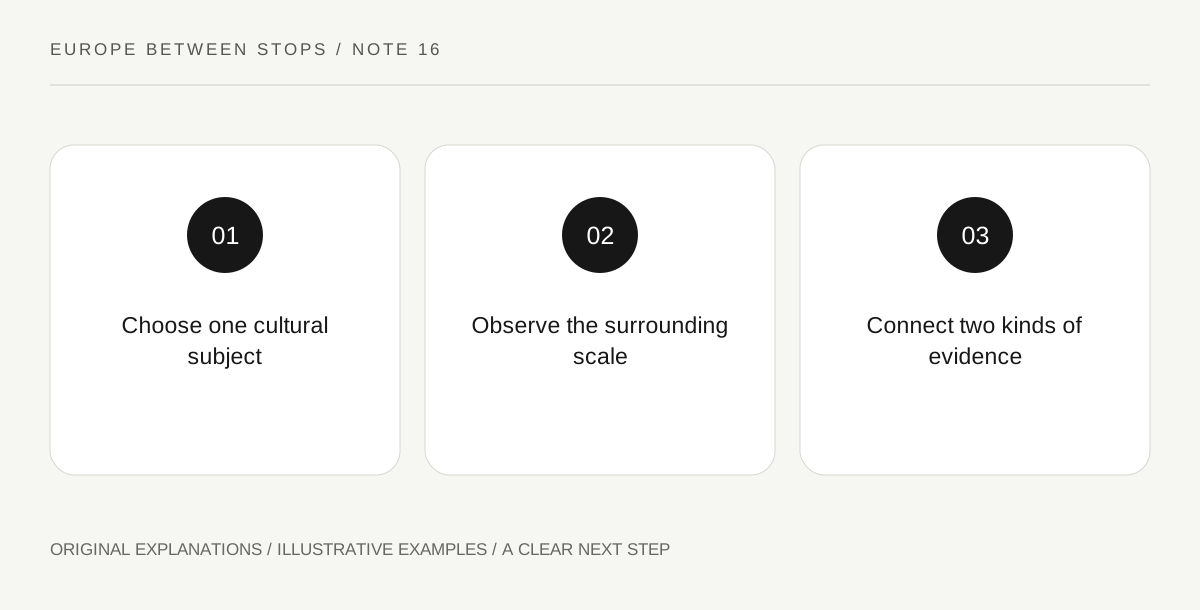
Original explanatory diagram. Read the full method and limitations below.
Begin with the town’s cultural context
UNESCO describes Urbino as a small hill town whose fifteenth-century cultural flourishing attracted artists and scholars and whose Renaissance appearance has been substantially retained. This supports a question about the relationship between cultural concentration and urban setting. It does not prove that every visible street or facade belongs to the same moment. Choose an identified cultural building or interpreted subject, then write what you hope to understand there. Keep that question narrow enough that one meaningful display or architectural relationship could answer it.
Observe a public relationship outside
Before or after the cultural visit, select an authorized public position where the chosen building or area relates visibly to the surrounding town. Describe changes in scale: a large volume beside smaller frontages, a space opening between streets or a building edge following the land. Do not take the exercise as a route recommendation; the actual gradients and access arrangements need current local information. The observation can remain short and close to an already planned stop. Its value comes from the relationship noticed, not the distance walked.
Ask what the interior study cannot explain alone
If you enter a museum or monument under its current arrangements, identify one interpreted object, room or feature relevant to your original question. Then ask what its display can establish about cultural activity and what it leaves unexplained about the wider town. A significant artwork does not by itself describe daily life in neighboring houses. Conversely, a street view cannot establish the intellectual exchange associated with a collection. Keep the evidence types complementary rather than asking either one to stand for everything.
Write a scale-changing conclusion
End with a pair of statements joined by a specific relationship. One should describe what the cultural interpretation established; the other should explain the visible town setting you actually examined. Avoid sweeping language such as the whole town was built for art unless a reliable source supports that claim. A successful notebook might explain how a large cultural presence sits within a smaller urban fabric, while leaving individual building histories unresolved. This gives Urbino a spatial identity alongside its cultural reputation and makes the visit easier to recall in concrete terms.
Illustrative field notebook
Illustrative notebook: a traveler selects one interpreted cultural subject, then observes its building’s relationship to nearby public space. The interior note concerns the documented subject; the exterior sketch concerns scale and setting. Their final paragraph connects the two without assigning a role to every neighboring house. A steep-looking distant street remains outside the exercise because it adds no necessary evidence to the chosen question.
Questions that come up
Is this useful without a long museum visit?
Yes, if the cultural subject is supported by appropriate interpretation and the observation is honestly scoped. Duration alone does not determine the quality of the connection.
Does a retained Renaissance appearance date every element?
No. An ensemble description is not a construction record for each street or building. Use specific evidence for specific historical claims.
References and scope
These sources support the factual background. Examples and exercises are original illustrative teaching material. References do not imply endorsement.
- UNESCO: Historic Centre of Urbino — The hill-town setting, fifteenth-century cultural flourishing and retained Renaissance appearance; no individual building chronology or route suitability is inferred.