Town patterns3 min read
A Brugge visit can move beyond collecting attractive street scenes by comparing two scales: the individual urban plot and the larger public institution. Choose a modest stretch of street and one identified civic or religious building. The question is how private edges and collective spaces help make the historic centre understandable as a working town.
Read the guide ↗
Working places3 min read
At a printing museum, a press can dominate attention so completely that publishing disappears. Use the Plantin-Moretus complex to ask how an object, an archive and a finished page provide different kinds of evidence. A focused visit follows a question about production and business rather than trying to memorize every machine or reproduce its operation.
Read the guide ↗
Working places3 min read
An enclosed historic community may look like a ready-made museum route, yet its residential character deserves a different kind of attention. At a Flemish béguinage, focus on the relationship between shared space and individual thresholds. The exercise is to understand a community’s spatial organization while keeping present residents and access boundaries visible in your planning.
Read the guide ↗
Land and water3 min read
Two points that look close on a flat map can tell very different stories in Luxembourg’s old quarters. Begin with a sketch of height and separation instead of immediately joining every visible landmark. This turns the city’s fortified setting into an observation question and keeps the wish to understand a landscape separate from assumptions about how to move through it.
Read the guide ↗
Layers of time3 min read
A city associated with Roman history can tempt visitors to place every important building on one mental timeline. In Trier, use separate time cards for a small selection of identified monuments. The aim is to distinguish what survives, which historical phase a label describes and how a building’s later life complicates the first impression.
Read the guide ↗
Working places3 min read
An old town can be remembered entirely through monumental buildings even when food production is part of its historic urban story. In Bamberg, add a question about growing and distribution to the visit. This changes which map features and interpretation you seek without turning private gardens into visitor attractions or inventing a surviving medieval supply chain.
Read the guide ↗
Layers of time3 min read
Timber framing offers a memorable visual pattern, but a pattern is not a construction date. In Quedlinburg, separate a careful description of a house front from the historical claims attached to it. A short two-building comparison can reveal how easily the phrase medieval town becomes an unsupported date for every building in a photograph.
Read the guide ↗
Land and water3 min read
A bridge photograph can isolate an impressive object from the places it connects. In Regensburg, keep both ends and the wider river setting in the notebook. The question is how a crossing participates in a trading town’s spatial organization, with present movement and historical interpretation kept separate rather than blended into one timeless scene.
Read the guide ↗
Town patterns3 min read
A shared heritage designation can make a city centre and a palace seem like one continuous attraction. For Graz and Schloss Eggenberg, choose two distinct observation tasks before deciding whether both belong in the trip. The useful comparison asks how urban fabric and a designed estate express related histories at different scales and under different visitor arrangements.
Read the guide ↗
Town patterns3 min read
A striking Salzburg view can make the historic centre appear like a single composed scene from one period. Use that first impression as the beginning of a study rather than its conclusion. Compare the view’s framing with the evidence of different building phases, and ask which parts of an urban story disappear when one image becomes the whole city.
Read the guide ↗
Land and water3 min read
A curving river can make a small town feel surprisingly difficult to hold in one mental picture. In Český Krumlov, compare the map’s river shape with a few identified views from permitted public spaces. The task is to understand the relationship among town, river and castle, without making a riverbank shortcut or a panoramic climb part of the exercise.
Read the guide ↗
Town patterns3 min read
Telč’s market square offers a useful visual puzzle: a continuous frontage can also contain strongly individual houses. Study those two scales separately before calling the square uniform. A simple rhythm drawing and one close description help explain how an ensemble can feel coherent without requiring every facade, opening or decorative choice to be the same.
Read the guide ↗
Town patterns3 min read
The phrase ideal city can make a historic plan sound like a finished diagram with no room for ordinary life. In Zamość, compare the broad organization of the old city with one public corner at ground level. The exercise asks how a planned pattern becomes a place experienced through approaches, thresholds and changing directions rather than only from above.
Read the guide ↗
Layers of time3 min read
The word new can quietly distort a visitor’s expectations when it appears on a historic-town map. In Toruń, treat Old Town and New Town as names that need historical context, not as an automatic contrast between medieval and modern scenery. Compare the identified areas through evidence of their roles and surviving buildings rather than trusting the labels alone.
Read the guide ↗
Town patterns3 min read
A long heritage title can conceal two very different scales of travel. In Ferrara, separate a close study of urban planning from an interest in the wider Po Delta cultural landscape. Begin with one question about the city’s Renaissance extension, then decide whether a second landscape question deserves a separate plan instead of treating the title as a ready-made day trip.
Read the guide ↗
Town patterns3 min read
A major cultural building can occupy so much attention that the town around it becomes only an approach. In Urbino, reserve part of the visit for a change of scale. Compare one documented monument-related question with a public-space observation about the hill town, so that the setting becomes part of the inquiry rather than background between ticketed rooms.
Read the guide ↗
Working places3 min read
A familiar architectural label can make very different buildings seem like variations of one decorative recipe. Around Vicenza, begin with a building’s documented purpose before comparing the visible forms associated with Palladio. The exercise helps distinguish an urban commission from a villa and makes the stylistic vocabulary serve an explanation rather than replace it.
Read the guide ↗
Layers of time3 min read
Two similar-looking words can create a surprisingly large misunderstanding in a historic city. In Arles, give Roman and Romanesque separate entries before comparing monuments. The exercise is partly about chronology and partly about language: the name of a later architectural tradition should not quietly become a claim that a building belongs to ancient Rome.
Read the guide ↗
Land and water3 min read
A palace and a bridge can share one heritage title while asking visitors to notice very different things. In Avignon, treat the surviving bridge as evidence of a former connection and the papal complex as an institutional ensemble. A focused comparison can reveal how power, movement and the river setting belong together without turning them into one undifferentiated monument stop.
Read the guide ↗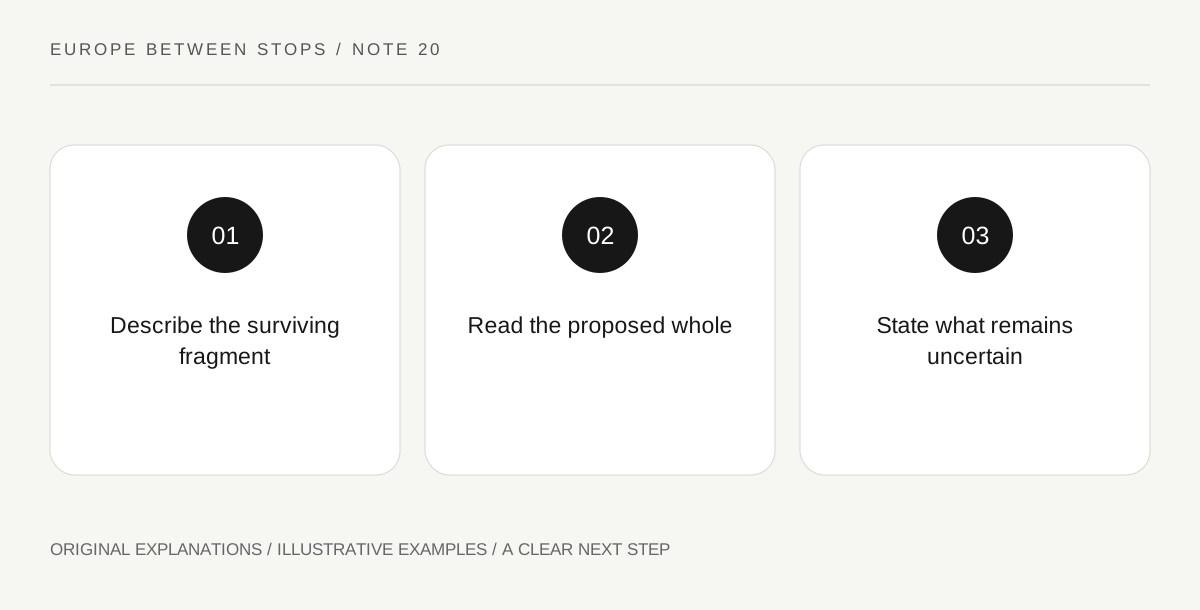
Layers of time3 min read
Archaeological remains in a living city can require more imagination than an intact monument, which makes the evidence boundary especially important. In Tarragona, choose one officially interpreted fragment and study how it relates to a proposed larger structure. The aim is to understand what the fragment establishes, what interpretation adds and which parts of the ancient city remain unresolved.
Read the guide ↗